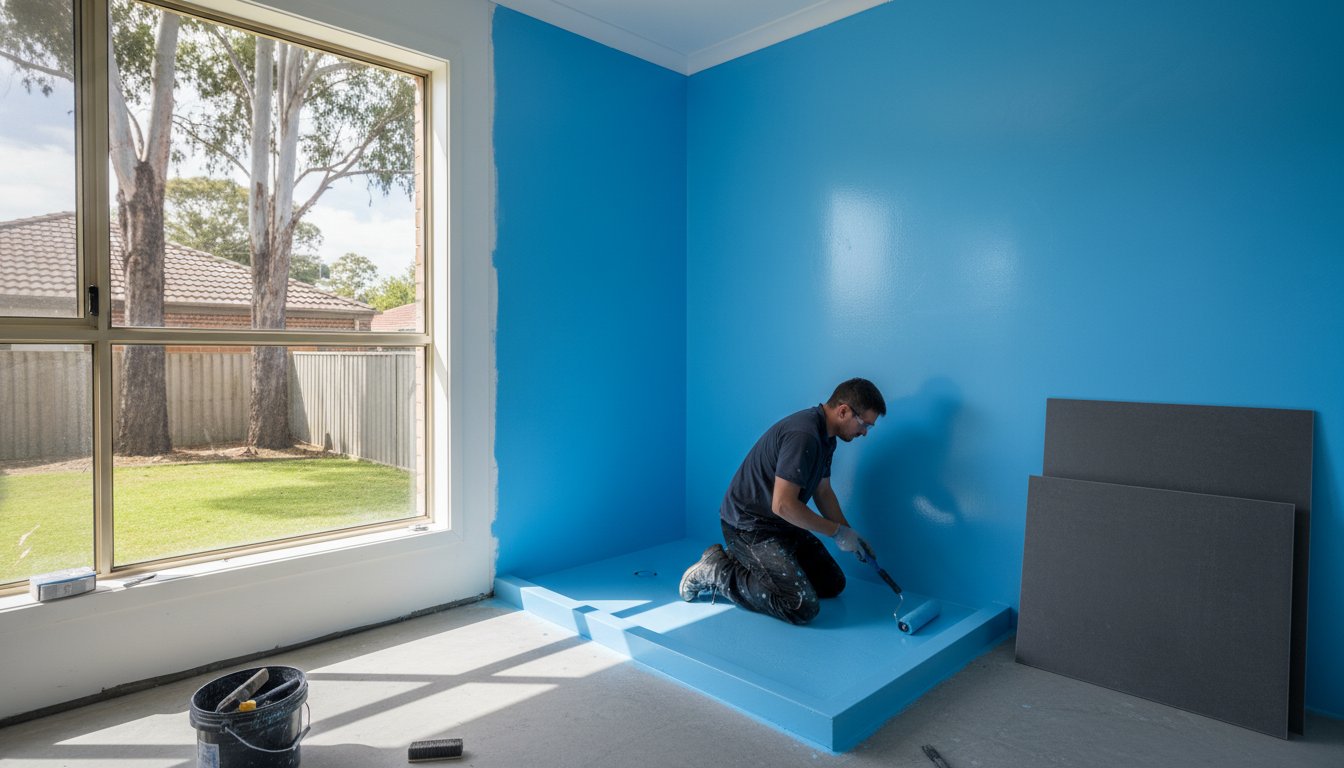
A single failed joint in your shower can quietly rot your home’s structural timber for years before a single damp spot ever appears on the ceiling. It’s a silent threat that turns a beautiful renovation into a structural liability. You likely understand that bathroom waterproofing sydney is the most critical stage of your build, yet finding clear information on Australian Standards or avoiding contractors who skip certificates remains a significant challenge. You want a bathroom that stays dry, smells fresh, and remains fully compliant with NSW regulations.
This professional guide clarifies exactly what’s required to protect your asset for decades. We’ll explain the mandatory AS 3740-2021 standards, including the rigorous 2026 updates regarding membrane thickness and junction sealing. You’ll discover the technical steps involved in a professional installation and why a valid compliance certificate is your only real defence against future insurance denials. From shower wall heights to floor gradients, we provide the expert secrets to ensuring your wet area is a fully engineered system rather than just a coat of paint.
Key Takeaways
- Understand the mandatory requirements of AS 3740-2021 and the critical 2026 updates that dictate membrane thickness and junction sealing.
- Learn why Sydney’s reactive soils and humidity make professional bathroom waterproofing sydney a non-negotiable defence against hidden structural rot.
- Identify the warning signs of substandard work, such as skipping substrate preparation or failing to provide a legal compliance certificate.
- Discover the technical multi-step process required to create a durable, engineered barrier that withstands building movement for decades.
- Explore the benefits of a dual waterproofing and tiling approach to eliminate professional “finger-pointing” and ensure a seamless, leak-proof finish.
Understanding Bathroom Waterproofing in Sydney: Why It’s Your Home’s Most Critical Defence
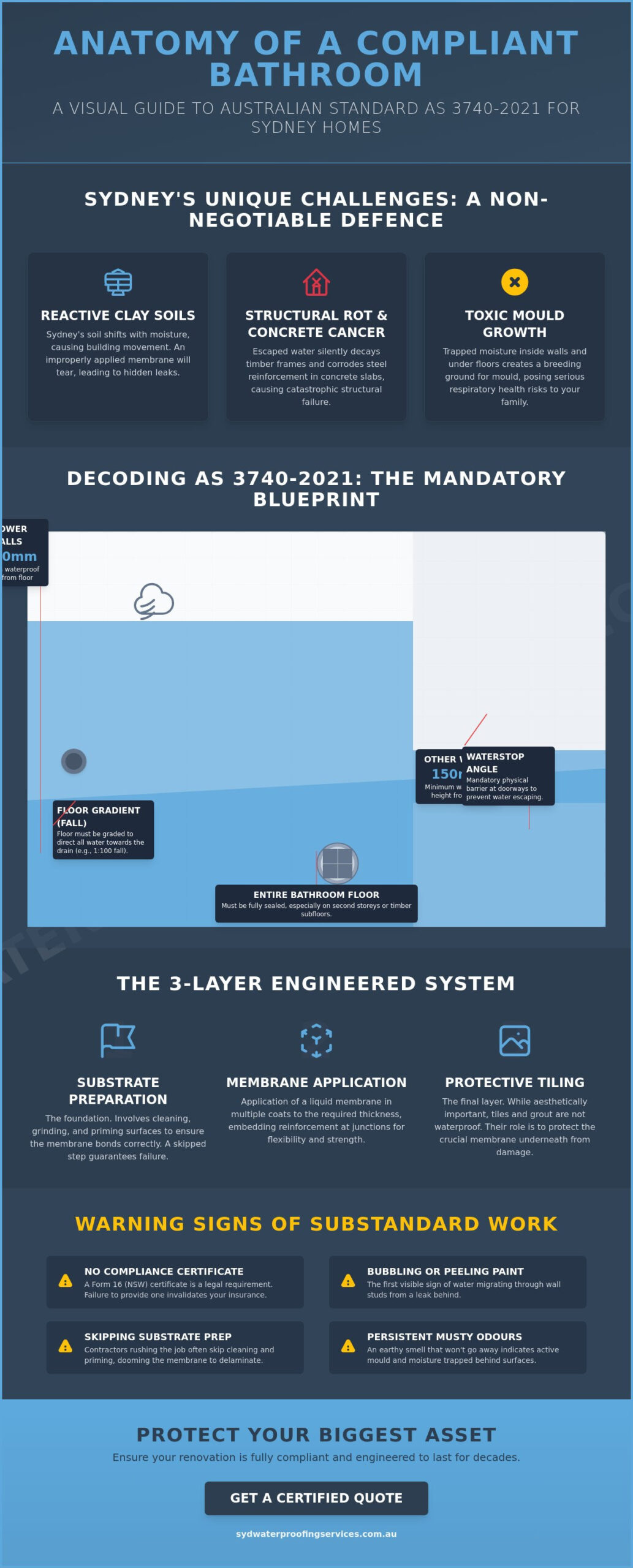
Waterproofing is the technical process of making a structure waterproof by installing a resilient, physical barrier between your wet areas and the building’s skeleton. For homeowners, professional bathroom waterproofing sydney serves as the primary line of defence against structural degradation. Sydney’s geography presents specific challenges that many generic guides overlook. Much of Greater Sydney is built on reactive clay soils. These soils shift significantly with moisture changes, causing houses to “breathe” and move. If a waterproofing membrane is too brittle or poorly applied, these micro-movements create tears that allow water to bypass the barrier.
When water escapes the shower tray or floor area, the consequences are both expensive and dangerous. In timber-framed homes, moisture leads to rapid structural rot, compromising the integrity of floor joists. In Sydney’s many high-rise apartments, persistent leaks cause “concrete cancer,” where water corrodes the internal steel reinforcement of the slab, leading to spalling and structural instability. Beyond the building itself, trapped moisture creates a breeding ground for toxic mould and mildew. These spores often grow undetected behind tiles or inside wall cavities, posing serious respiratory risks to your family.
The Role of Waterproofing in Property Value
A bathroom renovation is a major investment, but its value is only as secure as the seal beneath the tiles. In the competitive Sydney real estate market, savvy buyers and building inspectors prioritising long-term security will always look for a valid waterproofing certificate. Professional sealing also prevents efflorescence, that unsightly white salty crust that erupts through grout lines when minerals are leached out by moisture. For investors in areas like Seven Hills and across Greater Sydney, high-quality bathroom waterproofing sydney ensures your asset remains a “set and forget” investment rather than a source of remedial nightmares.
Identifying the Signs of Waterproofing Failure
You don’t always need to see a puddle to know there’s a problem. Look for bubbling or peeling paint on the reverse side of bathroom walls; this is often the first sign of water migrating through the studs. Musty, earthy odours that persist despite cleaning are another red flag, as is dampness or staining on carpets in adjacent rooms. The most dangerous leaks are “silent.” They occur beneath the floorboards or within the wall cavity, slowly hollowing out your home’s structure without ever appearing on the surface of your tiles.
The Anatomy of a Waterproof Wet Area: Australian Standards (AS 3740) Explained
Compliance with Australian Standard AS 3740-2021 is the legal benchmark for every wet area installation in the country. It isn’t a set of suggestions; it’s a mandatory regulatory framework designed to ensure your home remains structurally sound. A compliant wet area is built as a three-layer engineered system. This starts with meticulous substrate preparation, followed by the application of a high-performance membrane, and finishes with protective tiling. Without this disciplined approach, even the most expensive tiles won’t prevent water from migrating into your wall cavities.
The standard identifies specific “critical zones” that require different levels of protection. For example, shower recesses are high-risk areas. AS 3740-2021 mandates that shower walls must be waterproofed to a minimum height of 1800mm, while bathroom walls generally require protection to at least 150mm above the finished floor level. In Sydney, where many homes feature timber flooring or are situated on second storeys, the entire bathroom floor must be sealed to prevent gravity from pulling moisture through the ceiling below. A vital component in this system is the “waterstop” angle. This physical barrier is installed at doorways and shower perimeters to stop water from “wicking” through the tile bedding into dry areas of the home.
Membranes and Materials: Choosing the Right Shield
Most bathroom waterproofing sydney projects utilise liquid-applied membranes. These products are favoured for their ability to create a seamless, flexible skin that conforms to complex layouts and drainage points. For commercial environments or areas prone to extreme structural shifting, high-durability sheet membranes may be required. Regardless of the material, the success of the barrier depends on the primer. A professional primer creates a permanent chemical bond between the substrate and the membrane, ensuring the shield doesn’t delaminate over time. If you’re unsure which system suits your specific floor type, consulting with certified waterproofing specialists can provide the technical clarity you need.
Bond Breakers and Joint Sealing
One of the most common reasons for waterproofing failure is the lack of “bond breakers” at floor-to-wall junctions. As Sydney homes shift due to reactive soils, these joints move. A bond breaker allows the membrane to stretch independently of the substrate, preventing it from snapping like a rubber band under tension. This is distinct from standard silicone caulking; it’s a structural requirement for long-term durability. Additionally, expansion joints must be strategically placed throughout the tiled surface. These joints absorb the thermal expansion caused by Sydney’s temperature fluctuations, preventing your tiles from cracking or lifting.
The Real Cost of ‘Cheap’ Waterproofing: Avoiding Remedial Nightmares in Sydney
Choosing a budget contractor for bathroom waterproofing sydney often leads to what industry veterans call the “Two-Year Failure.” This is the window where substandard membranes begin to delaminate or tear because they lack the elasticity to handle building movement. Since the damage occurs silently behind the tiles, you won’t notice the breach until your structural timber has already begun to rot. By this stage, the unlicensed “handyman” who performed the work has usually vanished; leaving you to foot a repair bill that can easily reach tens of thousands of dollars for a full bathroom rebuild.
Protecting your investment requires vigilance during the installation phase. You must watch for these critical red flags that signal a high risk of future failure:
- Skipping substrate preparation: Professional installers must grind the floor to remove old adhesives, oils, and dust. A membrane applied to a dirty surface will never bond correctly and will eventually peel away.
- The “one-coat” shortcut: AS 3740-2021 requires specific membrane thicknesses. Applying a single thin layer is a recipe for disaster. The 2026 updates to these standards mandate even stricter documentation of membrane thickness readings.
- Rushing the process: Most high-quality liquid membranes require a full 24-hour curing period between coats. Tradies who apply a second coat immediately after the first are compromising the chemical integrity of the entire barrier.
- Missing documentation: In NSW, it’s a legal requirement to receive a formal Waterproofing Certificate of Compliance. If a tradie can’t provide this, the work is likely non-compliant and your insurance may be void if a claim arises.
Remedial Waterproofing vs. New Installation
Many homeowners hope a simple bead of silicone or a topical sealant can stop a structural leak. While topical sealants have their place for minor maintenance, they are temporary fixes that fail to address the underlying issue. Permanent bathroom waterproofing sydney requires a system-based approach that addresses the root cause of water ingress. Sydney Waterproofing Services prioritises permanent remedial solutions over quick fixes. We understand that trapping water under a “patch” only accelerates the decay of your subfloor, making a definitive fix essential for the safety of your home.
The True ROI of Professional Installation
The return on investment for professional installation lies in asset protection and insurance security. Most Sydney insurers will flatly reject water damage claims if the waterproofing wasn’t performed by a licensed professional or if a compliance certificate is missing. A professional installation typically comes with a long-term warranty, providing a definitive shield against future financial loss. When you consider that a mid-range bathroom renovation in Sydney costs between A$15,000 and A$30,000, paying for expert waterproofing is a small price for total peace of mind.
The Professional Waterproofing Process: From Preparation to Certification
Execution defines the lifespan of your wet area. While many contractors view waterproofing as a secondary task before tiling, a professional specialist treats it as a precision engineering phase. Our disciplined approach to bathroom waterproofing sydney ensures every vulnerability is addressed through a rigorous, five-step workflow. This methodical process eliminates the guesswork that leads to the remedial nightmares discussed earlier.
- Step 1: Substrate Inspection & Preparation. We begin by grinding the concrete or scuffing the floor sheeting to remove laitance, old adhesives, and dust. The surface must be structurally sound and chemically clean.
- Step 2: Priming. A high-performance primer is applied to penetrate the substrate. This creates a reliable chemical “bridge” that ensures the membrane bonds permanently rather than just sitting on the surface.
- Step 3: Detailing. We install bond breakers and reinforcing bandages at all floor-to-wall junctions and internal corners. These components allow the system to flex without tearing.
- Step 4: Membrane Application. We apply a minimum of two coats. In line with the 2026 updates to AS 3740, we use a Wet Film Thickness (WFT) gauge to document that the membrane meets the manufacturer’s exact specifications.
- Step 5: Curing & Testing. The system must cure for at least 24 hours. For high-risk areas, we perform a “flood test” by plugging the drains and filling the area with water to verify total integrity before a single tile is laid.
Surface Preparation: The Secret to Longevity
Longevity starts with what you can’t see. Before applying any product, we use moisture meters to ensure the substrate’s moisture content is within safe limits; typically below 5% for concrete. If the slab is too damp, the membrane will eventually blister and fail. We also verify the “falls” or gradients of the floor. Water must move efficiently toward the floor waste at a ratio of at least 1:60 in shower areas. If the substrate isn’t correctly levelled or the floor wastes aren’t flush, water will pool under your tiles, leading to stagnant odours and grout deterioration.
Compliance and the NSW Waterproofing Certificate
In New South Wales, your project isn’t legally complete without a formal Waterproofing Certificate of Compliance. This document is a critical piece of your property’s history. It must include the installer’s licence number, the specific products used, and a declaration that the work complies with AS 3740. For new builds or major renovations, this certificate forms part of the “Form 15” documentation required by your Private Certifier or local council. To secure a compliant installation for your renovation, contact our specialist team today. We provide full documentation for every project, giving you a definitive paper trail for insurance and future resale value.
Securing Your Sydney Property with Certified Waterproofing Specialists
Choosing the right partner for bathroom waterproofing sydney is the final step in securing your home’s future. Sydney Waterproofing Services has spent over two decades refining our processes in Seven Hills; encountering every possible structural challenge Sydney’s unique landscape offers. We understand that a wet area is only as strong as its weakest point. This is why we advocate for a dual ‘Waterproofing and Tiling’ approach. By managing both the membrane application and the final tiling, we eliminate the common industry issue of trades blaming each other for failures. You receive a single point of accountability and a finished product where the tiles and the barrier work in perfect harmony.
Transparency is a cornerstone of our professional integrity. We provide fixed-scope quoting to protect our clients from the hidden surprises that often emerge once old tiles are removed. Our senior technicians assess the structural needs of your bathroom with precision, ensuring that the quote you receive is comprehensive and final. This commitment to honesty has made us a trusted name for high-standard remedial work across the Greater Sydney community. We don’t just patch leaks; we restore the structural health of your property through disciplined, permanent solutions.
Why Choose a Local Seven Hills Specialist?
Being based in Seven Hills allows us to provide a rapid response for remedial inspections across Western Sydney. We possess a deep understanding of local building styles, from heritage cottages to modern high-rise apartments. Our team stays current with the specific requirements of local councils, ensuring every project meets or exceeds the necessary compliance standards. When you work with us, you gain direct access to senior technicians who provide expert advice grounded in decades of local site experience rather than a generic call centre.
Ready to Protect Your Bathroom?
Securing your home shouldn’t be a complicated process. We offer a ‘Same Week’ availability promise for urgent remedial quotes, ensuring that active leaks are addressed before they cause further structural rot. You can book a professional inspection and moisture assessment to identify the exact state of your wet area’s health. Our team uses advanced diagnostic tools to find the source of ingress without unnecessary demolition. Contact Sydney Waterproofing Services for a fixed-scope quote today and take the first step toward a permanently leak-proof home.
Protect Your Home with Engineered Waterproofing Solutions
Professional bathroom waterproofing sydney is more than a pre-tiling step; it’s a critical investment in your property’s long-term structural integrity. You now understand that a compliant wet area requires rigorous substrate preparation, disciplined multi-coat membrane application, and strict adherence to AS 3740-2021 standards. By prioritising a licensed specialist over a “quick fix” handyman, you avoid the devastating costs of remedial repairs and ensure your home remains a safe, mould-free environment for your family. A valid compliance certificate is your only definitive shield against future insurance denials and structural rot.
Sydney Waterproofing Services brings over 20 years of local expertise to every project. We provide fully licensed and insured (NSW) services that focus on durability and professional integrity. Every installation we perform is fully AS 3740 compliant, giving you the legal certification needed for insurance and future resale peace of mind. Our team is ready to deliver a permanent, engineered solution tailored to your specific bathroom layout. Don’t leave your most valuable asset to chance. Get Your Professional Bathroom Waterproofing Quote today and secure a leak-free future for your home.
Frequently Asked Questions
How long does bathroom waterproofing take to dry in Sydney’s climate?
Most liquid-applied membranes require 24 hours of curing time between the first and second coats. In Sydney’s humid coastal conditions, you should allow a full 48 to 72 hours of total curing time before any tiles are laid. Rushing this stage compromises the chemical bond and leads to premature failure of the barrier.
Do I really need a waterproofing certificate for a small bathroom renovation in NSW?
Yes, a compliance certificate is a legal requirement for all residential wet area work in New South Wales. Even for a minor renovation, this document proves the work meets AS 3740 standards. It is essential for maintaining your home insurance validity and is a critical document requested by building inspectors during the property sale process.
Can I waterproof over existing tiles to stop a leak?
No, applying a membrane over existing tiles is not a permanent solution for a structural leak. Proper bathroom waterproofing sydney requires the membrane to be in direct contact with the substrate, such as the concrete slab or fibre cement sheeting. While topical sealants exist, they only offer a temporary reprieve and don’t address the underlying moisture issues.
What is the difference between a ‘bond breaker’ and ‘silicone’?
A bond breaker is a specialised tape or bandage installed at floor-to-wall junctions to allow the membrane to stretch during building movement. Silicone is a surface sealant used for aesthetic finishing and minor water deflection between tiles. While silicone is flexible, it cannot replace the structural role of a bond breaker in a compliant waterproofing system.
How many coats of waterproofing membrane are required by law?
Australian Standards mandate a minimum of two coats applied in opposite directions to ensure total coverage. These coats must achieve the specific Dry Film Thickness (DFT) recommended by the product manufacturer. Applying a single thick coat instead of two thin coats often leads to “mud-cracking” and a compromised, leaky barrier.
Is a leaking shower covered by home insurance in Sydney?
Most Sydney home insurance policies don’t cover damage caused by gradual waterproofing failure or “wear and tear.” They typically only cover sudden events like a burst pipe. If your shower has been leaking slowly into the wall cavity, the insurer will likely reject the claim due to a lack of maintenance or non-compliant installation.
How long should professional bathroom waterproofing last?
A professionally installed waterproofing system should protect your home for at least 15 years. High-quality membranes used in bathroom waterproofing sydney are engineered to withstand decades of use if the substrate was prepared correctly. Most reputable installers provide a warranty that aligns with the manufacturer’s product guarantee.
Can I do my own bathroom waterproofing and get it certified later?
No, you cannot legally certify DIY waterproofing after the work is finished. In NSW, the person performing the work must be a licensed specialist to issue the required Certificate of Compliance. Professionals can’t “sign off” on work they didn’t perform or supervise, as they would be held legally liable for any future structural failure.